
Walls of Intramuros, located along the southern bank of the Pasig River, is the oldest among the districts of the city of Manila, the capital of the Philippines. Its name, taken from the Latin, intra muros, literally "With in the walls", meaning within the wall enclosure of the city/fortress, also describes its structure as it is surrounded by thick, high walls and moats. During the Spanish Period, Intramuros was considered Manila itself.
Before the Spanish
The site of Intramuros was originally a large Malayan Muslim settlement named Maynilad headed by Rajah Soliman. The name came from may nilad, nilad being a water plant whose star-shaped flowers clustered in abundance along the low-lying riverbanks. The strategic location of Maynilad, being on the Pasig River and the Manila Bay, made it an ideal location for the locals to trade crafts and produce with other peoples of the then pre-Hispanic Philippines and other Asian countries, especially with ethnic Chinese merchants. Maynilad was also the seat of power for native chiefs who ruled the area before the Spaniards set foot on Philippine soil.
Spanish Rule
In 1570, Spanish conquistadors led by Martín de Goiti, Juan de Salcedo and Miguel López de Legazpi arrived in Manila. Goiti and Legazpi's men waged war on the Muslims and indigenous tagalog peoples before they were able to take control and establish a permanent settlment in the area. In 1571 after the Spaniards were victorious in battle, Legazpi made a peace pact with the native muslim rulers, who, in return, handed over Manila to the Spaniards. Citing the rich resources, strategic economic, political and military importance of Manila, Legazpi declared Manila as the new capital of the Spanish colony in the Philippines on June 24, 1571. The King of Spain, delighted at the new conquest achieved by Legazpi and his men, awarded Manila a coat of arms and declared it Ciudad Insigne y Siempre Leal ("Distinguished and ever loyal city"). The planning of the city of Manila was commenced by the Captain General - Governor, Miguel López de Legazpi, who established forts, roads, churches and schools. The plans for Intramuros were based on King Philip II's Royal Ordinance issued on July 3, 1573 in San Lorenzo, Spain. Its design was based upon a medieval castle structure and covered 64 hectares of land, surrounded by 8 metre thick stones and high walls that rise 22 metres.
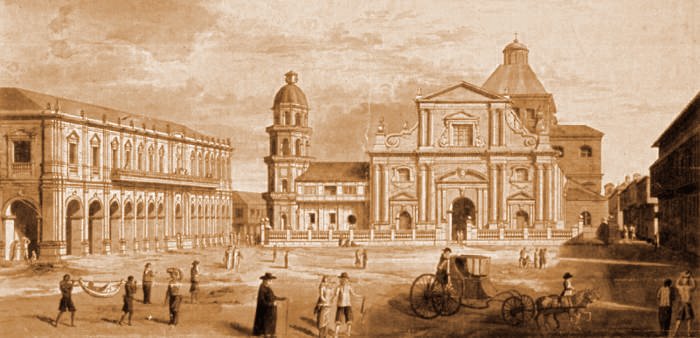
Intramuros was completed in 1606 and it served as the center of political, military and religious power of the Spaniards during the time that the Philippines was a colony of Spain. Inside Intramuros there are several Roman Catholic churches, like the Manila Cathedral and the San Agustin Church, convents and church-run schools, such as the University of Santo Tomas, the Colegio de San Juan de Letran and the Ateneo Municipal de Manila, which were usually being run by religious orders such as the Dominicans, Augustinians, Franciscans and Jesuits. The Governor's Palace, the official residence of Spanish Viceroyalties to the Philippines was originally in Intramuros before it was officially moved to Malacañang Palace and Fort Santiago. Only Spaniards and Mestizos were allowed to take part on political issues and take residence inside the walled city, Christian natives and ethnic chinese were also allowed inside, but Spanish officials prevented them living there. The vast majority of the natives and ethnic Chinese residents lived outside the walled city.
World War II
During World War II, much of Intramuros was damaged by bombings from both Japanese who occupied it and used it as their headquarters and prison and by U.S. forces who besieged the Japanese. Many of its historical structures were destroyed during the liberation, like the Manila Cathedral, Lourdes, Santo Domingo, San Francisco & it's chapel, the San Ignacio, church of the Recoletos the only one survived was the San Agustin Church. The schools were also destroyed like the Ateneo de Manila, Colegio de Sta. Isabel, University of Sto. Tomas, Colegio de Sta. Catalina, Colegio de San Juan de Letran & Colegio de Sta. Rosa. Only the last two remained after the war. Almost 100,000 civilians died during the liberation of Manila. Intramuros was in ruins after the war & the only structures survived was the San Agustin, almost all the other buildings left the walled City after the war
Present day
In the 1980s, under the direction of former Philippine First Lady Imelda Marcos, the Intramuros Administration restored the city and at present the walled city is the only district of Manila where old Spanish-era influences were retained. Much of the development of present-day Manila occurred outside the gates of Intramuros, leaving the old walls, streets and churches of Intramuros minimally touched by modernization, although outlets of Jollibee, McDonald's and Starbucks now sit alongside distinguished educational institutions within its walls. The old moats that surrounded Intramuros have been filled up and transformed into a golf course where locals and foreign nationals play the sport. The garrison that was Fort Santiago is now a tourist spot where visitors can enjoy the nostalgic romance of a bygone Spanish era within its gardens.
Intramuros now houses some of the higher education institutions in the Philippines. these are the Pamantasan ng Lungsod ng Maynila, Mapúa Institute of Technology, Lyceum of the Philippines University,Colegio de San Juan de Letran and Colegio de Sta. Rosa. There are also places in Intramuros called Baluartes. Baluarte is a Spanish word for "bastion". these places are strongholds of Spaniards during the Spanish era. there are notable baluartes in Intramuros. these are Baluarte de San Diego, Baluarte de San Gabriel, Baluarte de Sta Barbara and Baluarte de San Andres. the ruins of these places are now good tourist and historical attractions.
Intramuros now houses some of the higher education institutions in the Philippines. these are the Pamantasan ng Lungsod ng Maynila, Mapúa Institute of Technology, Lyceum of the Philippines University,Colegio de San Juan de Letran and Colegio de Sta. Rosa. There are also places in Intramuros called Baluartes. Baluarte is a Spanish word for "bastion". these places are strongholds of Spaniards during the Spanish era. there are notable baluartes in Intramuros. these are Baluarte de San Diego, Baluarte de San Gabriel, Baluarte de Sta Barbara and Baluarte de San Andres. the ruins of these places are now good tourist and historical attractions.
Thursday, January 06, 2005


Tuesday, December 28, 2004
Welcome to Calle Murada
Preface
 t's been on my college years when I was able to visit Intramuros. I was raised in the province and I seldom went to the big city of Manila. I always heard Intramuros from my relatives not just because it is the location of their school but to the stories that lies behind those walls.
The stories are quite intriguing in a sense that, some of it I can't believe. May be I'm just so young to be able to know those things that happens way back the spanish period. History really attracts me and I really enjoyed reading books about it during college. But the twist of my career path does not help me continue that passion for history books and it takes me away from it.
Now, that passion has been reborn because of photography. I was able to capture what is inside those walls of the old city of Manila. And I think I have lots of it already. Now, I wanna share these photos with stories that lies within it. I also want to gather pre-war and pre hispanic photos of Intramuros and try to figure out how it looks like during those period. The only problem is where the hell i gonna look for that archives. May be the power of internet would help me, but i think It is not enough. With this blog, I am encouraging volunteers to help me write and share photos about Intramuros. Through this, we can rebuild the moments that was century old treasure of Manila.
Introduction
For over four hundred years, Intramuros was Manila in the Spanish period and it withstood natural and man-made disasters. Intramuros was the center of the vast Spanish Empire in Asia. From within the confines of these adobe walls, governments ruled, religions prayed and converted, education taught, and a society prospered. Intramuros was Manila. And Manila ruled.
Now, as Intramuros is surrounded with huge infrastructures in the middle of bustling metropolis it became one of the famous tourist destination in the Philippines. It attracted local and foreign visitors every year that the government had reincarnated the glorious days of the walled-city of Manila. It has preserved and restored the walls that once found as remnants of the glorious city in the Spanish era.
With this blog, join me as I walk inside Ciudad Murada and go back to the historic past of this old city through images and let us realized the importance of one of our treasured heritage that we should continue to protect and enjoy for the our next generation.
Subscribe to:
Posts (Atom)
